Digital Rights - Scarlet Alliance

Skip to main content Skip to main navigation

Our new website is in testing. Spotted an error? Let us know!

Donate

Digital Rights

Internet services are vital for sex workers. We use them to advertise, make and sell content, connect with clients, manage payments, build community and share health and safety information. When platforms and governments crack down in the name of ‘online safety’, sex worker communities are left behind.

Sex workers are being pushed off and locked out of digital spaces by laws claiming to make the internet ‘safer’.

Discrimination against sex workers by big tech is nothing new. Our accounts, advertisements and content are routinely removed, restricted or hidden, often with little explanation or opportunity to appeal. Increasingly, online safety laws in the United States, United Kingdom and Australia have intensified the silencing and restriction of sex workers in digital spaces.

In the United States, anti-trafficking law FOSTA-SESTA resulted in mass deplatforming of sex workers and sex work spaces, with negative impacts on income, health, safety and community. Similar approaches to online regulation are now shaping digital spaces elsewhere, including the United Kingdom and Australia.

In Australia, the Online Safety Act 2021 is intended to stop young people from seeing adult content. In practice, it pushes tech companies to use blunt content moderation and ‘age assurance’ tools that incorrectly classify content and deplatform users. Sex workers lose accounts, income and the ability to reach our communities.

What are digital rights?

Digital rights are the rights people need to safely and fully participate in online spaces, and are a core part of the modern human rights framework. Yet sex workers in Australia and globally are frequently excluded from and discriminated against in these spaces.

  • Access and equality | Sex workers need to have equal access to online tools no matter who we are and where we live.
  • Freedom of expression and information | Sex workers should have the ability to choose what information we receive and share online, without censorship or fear.
  • Privacy and data protection | Sex workers need to be able to have the freedom to decide who has access to our personal data, and how it gets shared. This includes ‘the right to be forgotten.’
  • Anonymity and encryption | Sex workers must be able to communicate online safely and anonymously when we need. This includes the choice to use encryption technologies.

Australian and international online safety laws give regulators sweeping powers to investigate, restrict or remove online content considered ‘harmful’.

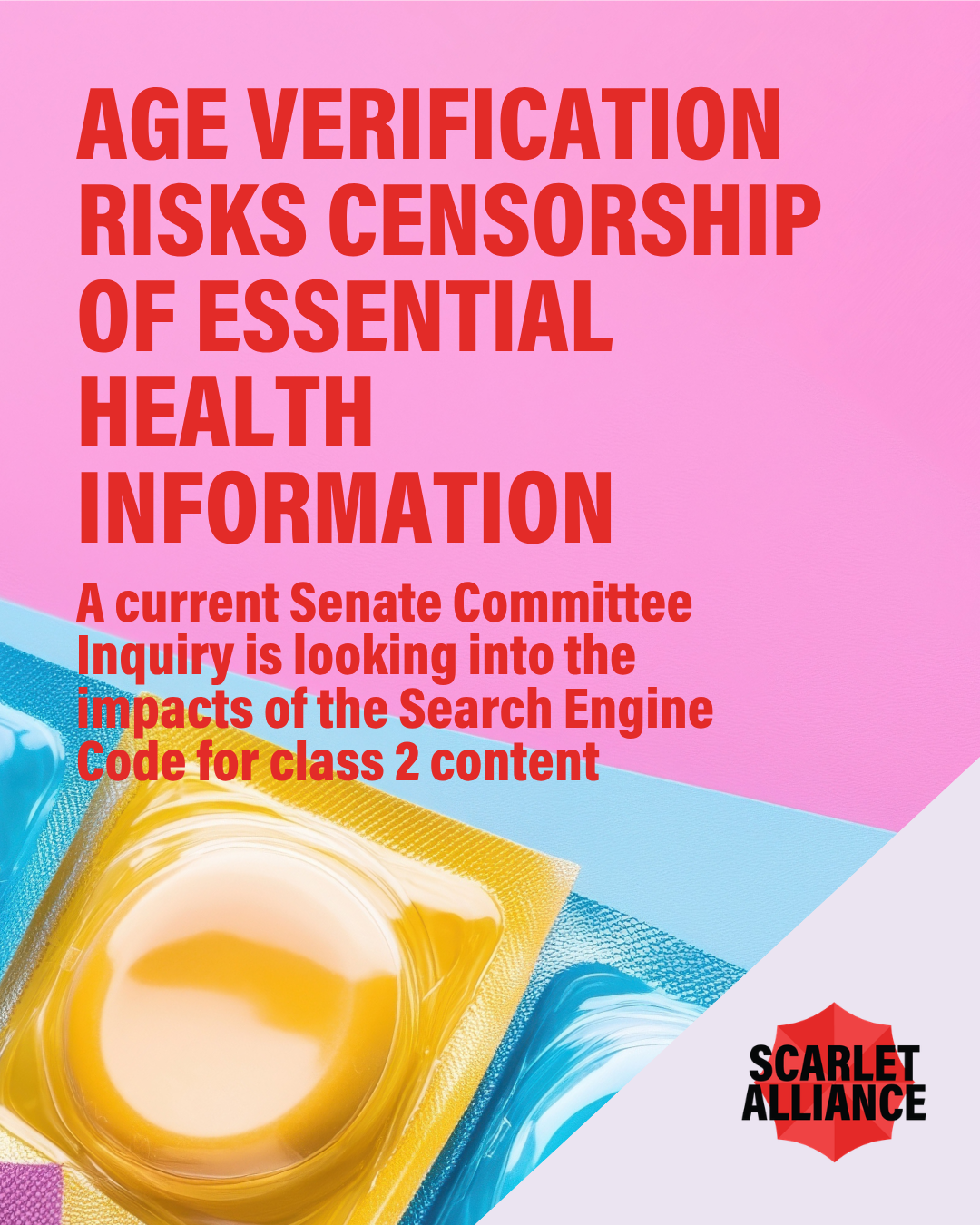
Many of these regulations also require tech companies to prevent people under 18 from accessing certain adult content, which risks platforms over-censoring content, including sexual health education and sex worker resources. These regulations apply to a wide range of internet technologies, including:

  • Search engines (e.g. Google)
  • Hosting services (e.g. GoDaddy)
  • Social media platforms (e.g. Instagram)
  • Messaging apps (e.g. WhatsApp)
  • Internet Service Providers (e.g. Optus)
  • App distribution services (e.g. Apple App Store)
  • Device manufacturers (e.g. Samsung).

How do online regulations and digital discrimination affect sex workers?

From censorship and surveillance to financial exclusion, digital technologies and online safety laws create barriers to sex workers’ rights, safety and participation online. Explore some of the ways these systems affect our lives and work.

Content moderation, shadowbanning and deplatforming

Platforms increasingly over-use AI to target, detect and remove sex worker content, but this software can’t tell the difference between sex and sex education, or between consensual content and abuse.

Sexual and reproductive health promotion often includes frank discussions and images, such as diagrams of anatomy, condom demonstrations, and depictions of sexual acts. Empirical studies show that automated and human moderators routinely misclassify such content as pornography. This has created a systematic suppression of sexual and reproductive health information across major platforms, and the suspension or removal of accounts by not-for-profit organisations, creators, and small businesses.

For sex workers, the consequences extend well beyond losing online visibility. Content moderation systems do not recognise state and territory laws such as sex work decriminalisation and anti-discrimination protections. The result is shadowbanning and deplatforming which undermines our income, mental health, political participation and ability to share vital safety information with each other. The laws sex workers fought for to protect our real life work lives do not currently extend our online lives.

Financial discrimination and digital exclusion

Digital surveillance and discriminatory algorithms are enabling banks, financial services and payment processors to deny sex workers access to the same services and platforms as everyone else.

Banks routinely close or refuse accounts for brothels, escort agencies and individual sex workers, often citing vague “reputational risk” policies rather than anything about how the business is actually run. Payment processors do the same: PayPal automatically flags anything linked to “sexually oriented” services, and Stripe shuts down sex work accounts on the same grounds. Airbnb uses algorithms to identify and exclude users it suspects are sex workers, based on flawed assumptions about risk rather than evidence.

These technologies cut sex workers off from basic financial infrastructure that every other business relies on, even in places where our work is legal. This is discrimination by design.

Digital surveillance, privacy and encryption

Rules that push platforms to scan messages and files for ‘illegal’ content may sound reasonable in principle. In practice, it means either breaking encryption (the protection that keeps what you send and store online private) or tech companies scanning all content on every users’ device before content is sent.

These systems aren’t accurate enough to be trusted with this kind of power, and sex workers are more exposed to their mistakes than most. There are no proposed means of avoiding, appealing or challenging incorrect categorisation of content – leaving sex workers open to being treated unfairly and at risk of privacy breaches.

‘Age assurance’ technology

Censorship is no substitute for comprehensive sexuality education or meaningful online safety.

When schools and parents fail to provide comprehensive, age-appropriate relationship and sexuality education, young people may turn to pornography to fill those gaps. Rather than addressing these gaps, Australia’s Online Safety Act 2021 requires tech companies to implement ‘age assurance’ technologies to prevent people under the age of 18 from seeing adult content. These technologies do not hold up as a solution – they are expensive to implement, often inaccurate, encourage platforms to collect and store unnecessary data, and easy to bypass with a VPN or someone else’s ID.

Faced with the costs and risks of compliance, platforms may instead choose blanket content removal and mass deplatforming over introducing expensive age-gating technologies or investing in human-moderated compliance measures.

This approach restricts sex workers’ access to digital platforms, and undermines our rights by removing the choice about where and how we work. It also drives users towards pirated or unregulated content and does little to address harms such as content scraping and non-consensual intimate image sharing.


Online safety or censorship?

Follow us on Instagram

Australia’s online safety regulations are changing how we access and share information, advertise our services and participate in digital spaces. Explore our posts breaking down age assurance, online censorship and what these changes mean for sex workers’ rights, income and safety.

Online safety or censorship?

Follow us on Instagram

Australia’s online safety regulations are changing how we access and share information, advertise our services and participate in digital spaces. Explore our posts breaking down age assurance, online censorship and what these changes mean for sex workers’ rights, income and safety.

New media, same old moral panic.

Sexually explicit media framed as a plague on society is nothing new. Over the decades, we have seen pornography and ultimately, sex workers, blamed for any and every societal moral panic.

As social awareness about gender-based violence has increased, some commentators have pointed the finger at porn and online sex work as a big part of the problem. However, research does not demonstrate a causal link between porn and violence, and there’s no solid evidence young people are consuming more porn than previous generations did through other media. Every new technology, from 1960s pulp fiction, to ‘video nasties’ in the 1980s and internet forums in the 1990s, has triggered the same panic.

Porn performers and adult content creators are sex workers. Policy built on moral panic rather than evidence doesn’t make anyone safer. It just makes it harder for us to work, connect and stay safe. Real online safety means listening to the people most affected by these laws, not designing around us.

Keep the conversation going.

Follow us on Instagram

We regularly share sex worker-led information about digital rights, online censorship, privacy and discrimination. Explore our latest posts for community perspectives, mythbusting, advocacy updates and practical information about the issues affecting sex workers online.

Keep the conversation going.

Follow us on Instagram

We regularly share sex worker-led information about digital rights, online censorship, privacy and discrimination. Explore our latest posts for community perspectives, mythbusting, advocacy updates and practical information about the issues affecting sex workers online.

From our library.

Explore more of our research, submissions and advocacy on digital rights, online censorship, privacy and the impacts of digital regulation on sex workers and our communities.

Submission on Modernising and Harmonising Classification Standards
Stigma and discrimination, Submissions
29 May 2026

Submission on Modernising and Harmonising Classification Standards

Read more about Submission on Modernising and Harmonising Classification Standards
Briefing Paper: Impacts of Pornography
Digital rights, Resources
24 September 2025

Briefing Paper: Impacts of Pornography

Read more about Briefing Paper: Impacts of Pornography
Briefing Paper: Draft Codes of Practice for the Online Industry (Class 1C and Class 2 Material)
Digital rights, Resources
30 June 2025

Briefing Paper: Draft Codes of Practice for the Online Industry (Class 1C and Class 2 Material)

Read more about Briefing Paper: Draft Codes of Practice for the Online Industry (Class 1C and Class 2 Material)
Submission on Internet Search Engine Services Online Safety Code Implementation
Digital rights, Submissions
22 September 2025

Submission on Internet Search Engine Services Online Safety Code Implementation

Read more about Submission on Internet Search Engine Services Online Safety Code Implementation
1 / 4